Case study · Web
Atlas del CuerpoInteractive 3D Anatomy Atlas
Open-source 3D atlas of human anatomy: 162 bilingual structures across 12 body systems, guided tours, quizzes, and spaced-repetition review, all in the browser with no login.
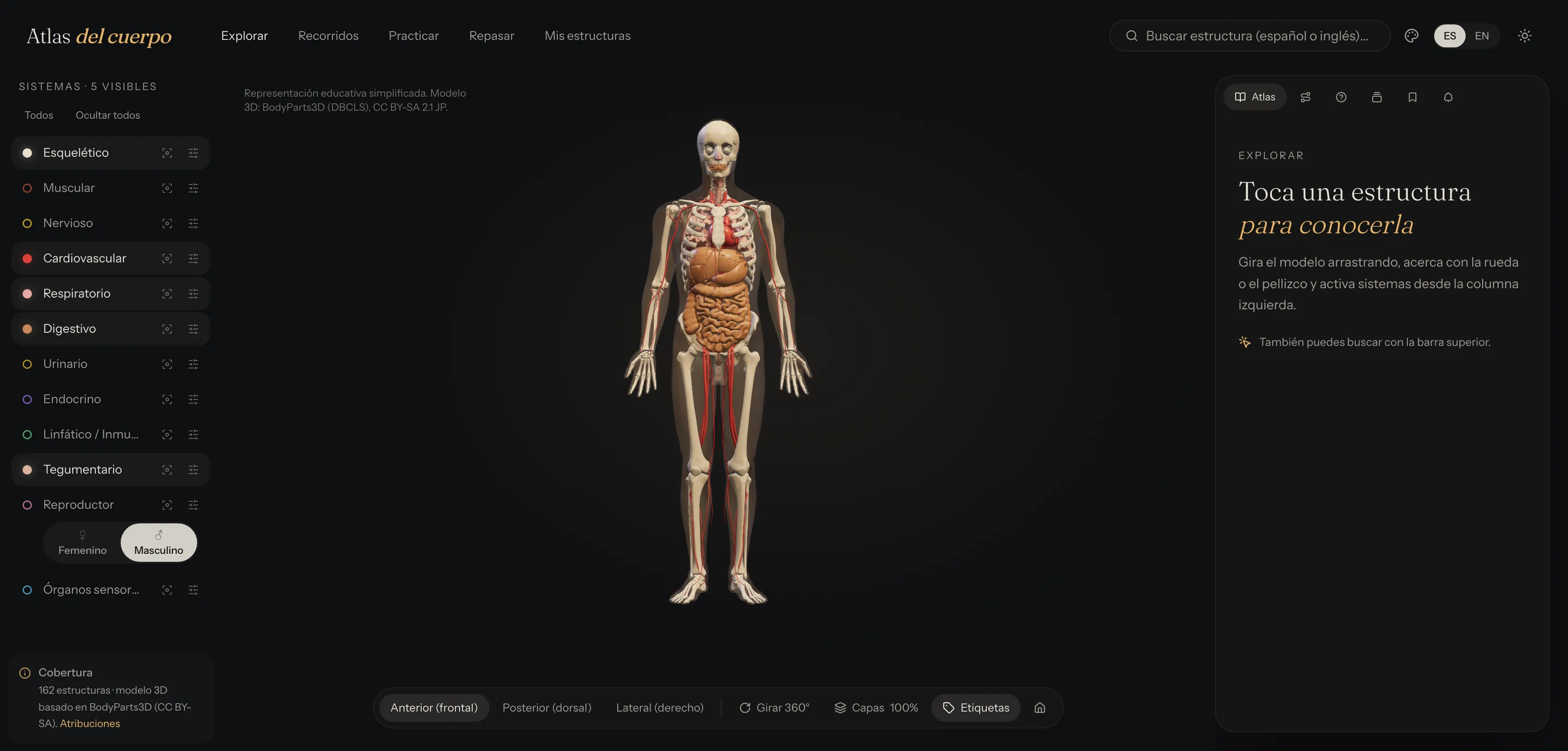
Project Overview
Atlas del Cuerpo is an educational, open-source anatomy atlas for high-school students and early health-science students. Built with Next.js 16 and React Three Fiber, it lets learners rotate, zoom, and isolate a full-body 3D model, open a bilingual (Spanish/English) card for each structure, and study with guided tours, quizzes, and a spaced-repetition review deck. Code is MIT and the content and 3D models are Creative Commons (CC BY-SA 4.0).
Role & Responsibilities
- Designed and built the whole product: 3D viewer, structure cards, guided tours, quiz, review screen, and progress panel.
- Wrote a Python pipeline that turns BodyParts3D source meshes (~870 MB of OBJ files) into one optimised GLB per body system, plus the manifest the app reads.
- Implemented a simplified SM-2 spaced-repetition engine that generates ~935 review cards from the structure data plus hand-written cards.
- Built a data validation script that checks ids, cross-references, translations, meshes, tours, and quiz items before every content change.
Key Challenges
- Keeping a full-body WebGL scene responsive on mid-range laptops and phones while toggling 12 systems and highlighting individual structures.
- Versioned, immutable caching of 3D models (
?v=MODEL_VERSION) so large GLB files stay cached at the CDN and in the browser without serving stale meshes. - Storing all progress (favourites, tours, quiz scores, review state) client-side with migrations, export, and import, so the atlas needs no accounts or database.
Outcomes
- 162 structures in 12 systems, 113 with a 3D model, 10 guided tours (77 steps), and 108 quiz questions, including “identify the highlighted structure” questions on the 3D model.
- Fully bilingual interface and content, with light and dark themes.
- Public repository with CI and a contribution workflow for teachers and health professionals reviewing the content.
Stack
- Frontend: Next.js 16, React 19, TypeScript, React Three Fiber, drei, three.js, Zustand, Tailwind CSS, Framer Motion.
- 3D pipeline: Python scripts mapping anatomical concepts to BodyParts3D meshes and exporting GLB per system.
- Quality: ESLint,
tsc --noEmit, data-integrity validation, store and SRS test scripts, GitHub Actions CI. - Hosting: Vercel.